Installing the Alipay app
The Alipay app is available from both the Apple App Store and the Google Play Store. We recommend installing and setting it up on your phone before you enter China, so that you are ready to go the moment you land.
The app is currently available in Chinese and English only. If you install it outside China, it switches automatically to the international version, with English as the default language.
Registration
To create a new account you will need a valid phone number. Follow the prompts to enter your number, then the verification code you receive — either as a text message or as a brief automated phone call that reads the code out to you. You will then be asked to set a password.

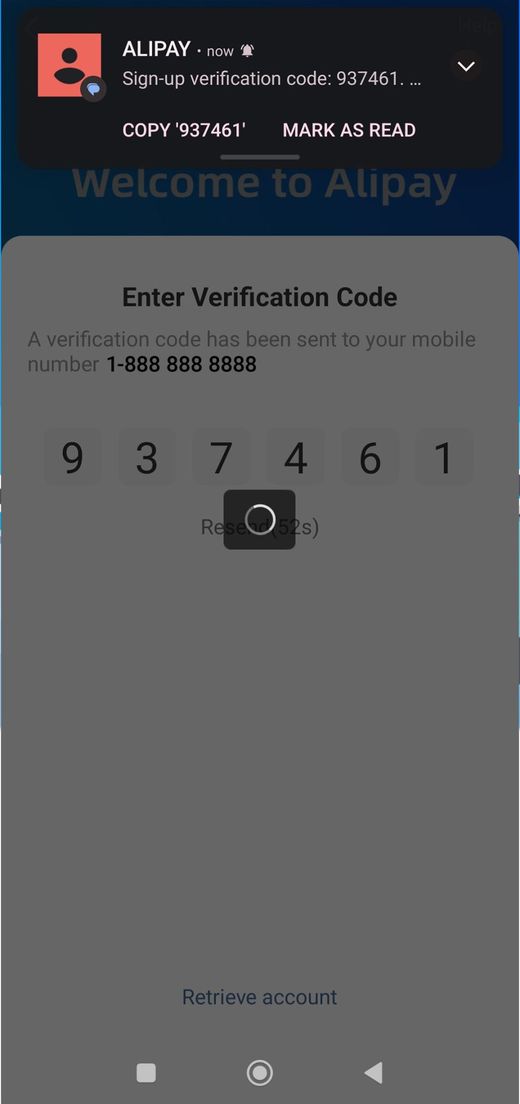
Verification
Under the changes announced by Alipay's Ant Group in March 2024, you may spend up to US$2,000 a year without registering your ID. For transactions over US$500 you will be asked to provide an ID to verify your account, so keep your passport or ID card to hand.
Once you have registered and verified your account, your annual transaction limit rises to US$50,000, with single transactions capped at US$5,000.
Topping up / linking your bank account
There are two main ways to connect a bank card to Alipay. The first is a direct, pay-as-you-go method that charges your card through the app each time you pay. The second is a prepaid system called TourCard, designed specifically for short-stay visitors, which lets you place funds into your Alipay account in advance. Both are open to international visitors with non-Chinese bank accounts. Read on to see which suits you best.
Option 1 — directly linking a bank card
Since 2023, Alipay has allowed users to add international payment cards. Tap "Add now" to add a bank card. You will first be asked to set a six-digit payment password — remember it, because you will need it every time you pay. Once the password is set, you can either scan your card with the camera icon or type in the card details. The app accepts Visa, Mastercard, Diners Club, Discover, JCB and UnionPay cards.
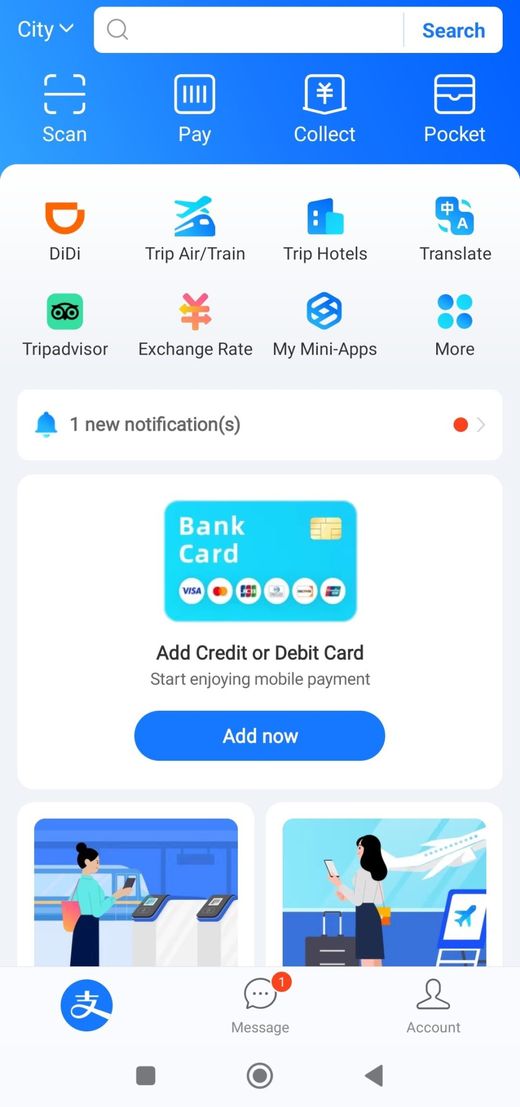
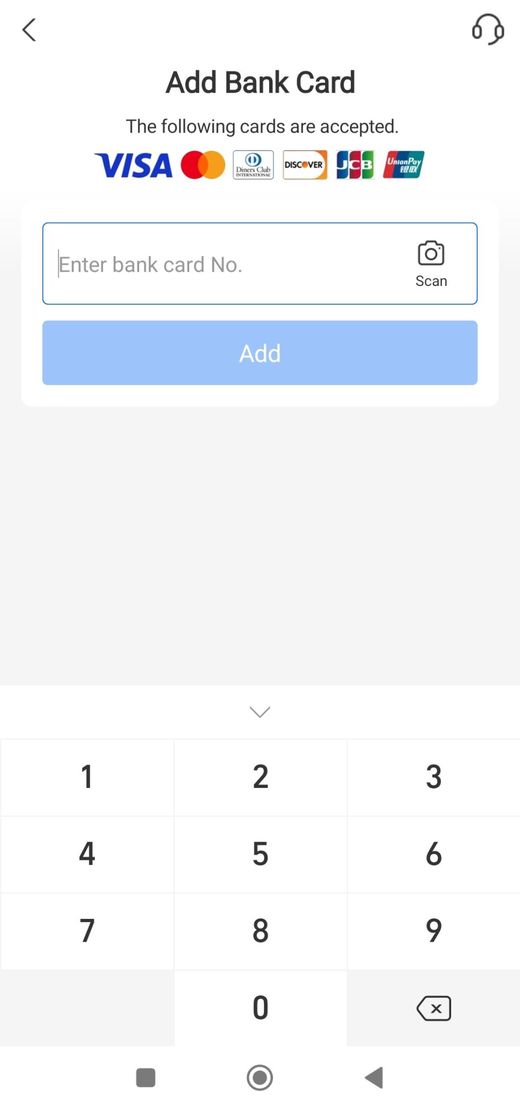
It is worth noting that some cards do not work. If that happens to you, the best approach is to try another card.
Once a card is registered you can start making payments, which are charged directly to that card. Each payment asks for your six-digit payment password.
Option 2 — a prepaid Alipay account via TourCard
Alipay has a mini-app called TourCard. Its advantage is that it opens a temporary virtual local bank account on Alipay, valid for 180 days, with a maximum top-up of CNY 10,000 over the whole period. Note that there is a 5% service charge on each top-up.
To activate TourCard, go to the search bar at the top of the app screen and type "TourCard". A "mini app" icon appears — tap it and follow the instructions to register. Have your ID or passport to hand, as the TourCard mini-app requires verification.
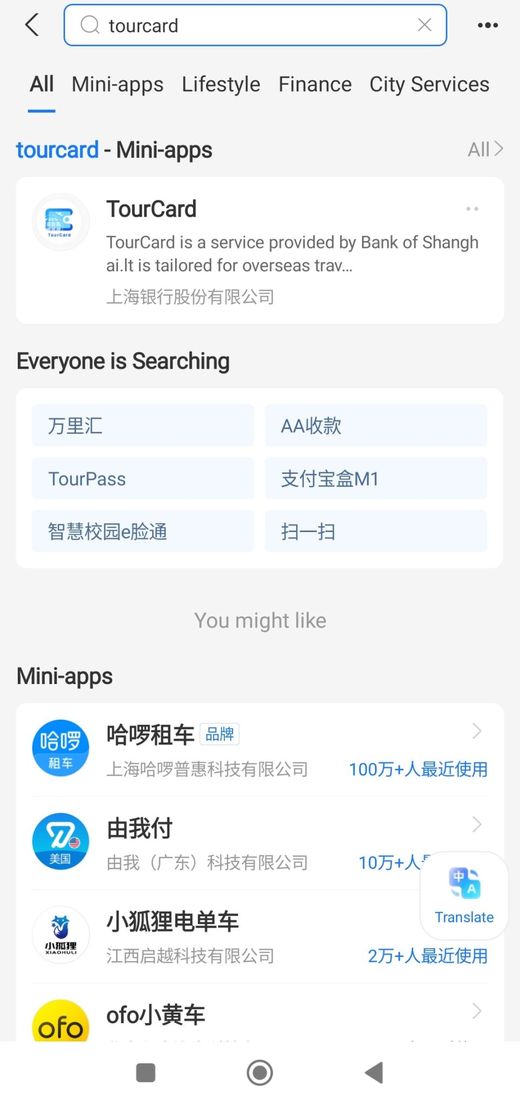
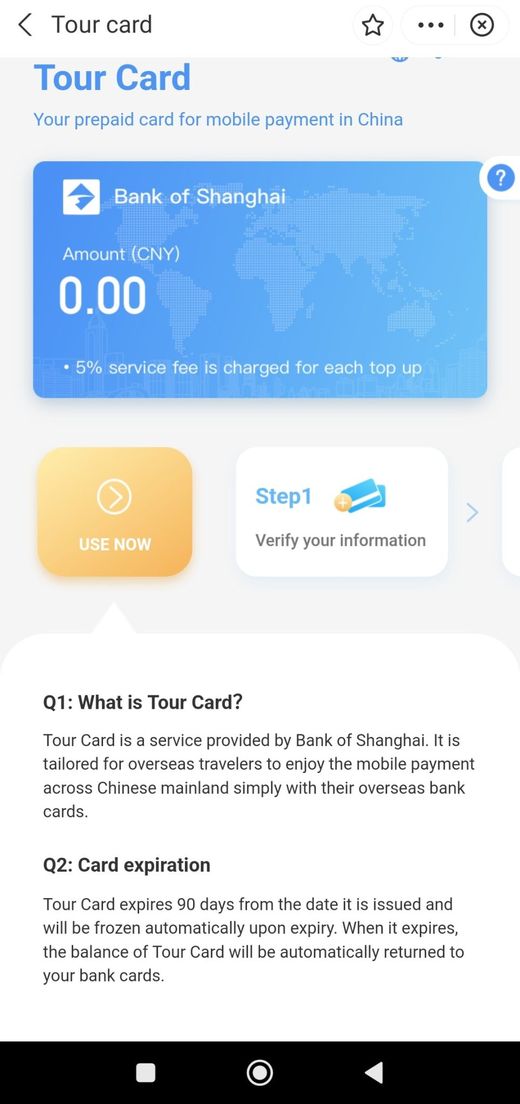
Put simply, TourCard is a prepaid feature that lets you place up to CNY 10,000 into your Alipay account for the duration of your stay — CNY 10,000 being the maximum possible during the initial 180 days. TourCard currently supports Visa, Mastercard, Diners Club International and JCB. American Express support is said to be coming, but as of now it is not yet available.
With those steps completed, you can proceed to pay merchants using Alipay. As with overseas cards linked under Option 1, you cannot send money to, or receive money from, individuals — it is strictly for purchases from businesses, online and in shops.
Using Alipay for payments
Now that you are set up, paying is fast and smooth. When paying a merchant, you will have two options.
Merchants scan your QR code. Whenever you need to pay for something, tap the "Pay/Receive" icon at the top of the screen. This displays your QR code, which the merchant scans to charge the right amount to your card. All you do is hold out the phone with the code visible.
You scan the merchant's QR code. Tap the "Scan" icon on the top row, next to "Pay/Receive", and scan the merchant's code. Sometimes you will need to ask for their code first. From there it is plain sailing.
If you are shopping online, choose Alipay as the payment method at check-out and you will be redirected to the app to complete the transaction. On a desktop, the check-out usually displays a QR code that you scan from your phone to finish paying.
Limitations
While Alipay lets you pay merchants, not every feature is available to international visitors. Peer-to-peer transfers, for instance, are not open to international users.
Depending on your home bank's security policy, you may also need to provide your card's CVC code and other security verification for some transactions.
Beyond payments: Alipay mini-programs
Alipay is not only a payment tool — it also works as a platform for mini-programs, apps within the app. These cover everything from transport and travel bookings to dining and attractions, often removing the need to download anything else.
Using Didi in Alipay
Didi, China's most popular ride-hailing service, can be accessed directly through Alipay. Here is how.
- Open the Alipay app.
- Look for the Didi icon on the home screen, or type "Didi" in the search bar.
- Allow the app to access your location, confirm your pick-up point and enter your destination — English and Chinese both work.
- Choose your ride type (Express, Premier and so on), confirm, and the fare is paid automatically through your linked card.
- After the ride a digital receipt appears in your Alipay account. If you do not speak Chinese, the built-in chat translation makes talking to your driver easier.
Frequently asked questions
Is Alipay safe? Yes. Alipay is regarded as a secure payment platform, and by following the usual best practice for digital security on your side you can use it with confidence.
Can I not just use my bank cards or cash? China's shift to a cashless, cardless society is remarkable. Many shops have no card reader at all and do not accept cards issued by Visa, Mastercard, Apple Pay or other international networks. Some merchants will still take cash if you pay the exact amount, but many have no change and will politely decline.
Can I link a foreign card to Alipay? Yes. Follow the steps in this guide and link your card. The app currently accepts Visa, Mastercard, Diners Club, Discover, JCB and UnionPay cards.
How long does ID verification take? The app says to allow up to 72 hours, but in practice it is often much quicker — some verifications are completed within the hour.
What are the transaction limits? The minimum transaction amount is CNY 10, about US$1.40. Unverified account holders may spend up to US$2,000 a year; verified users up to US$50,000 a year, with single transactions capped at US$5,000.
What is the top-up cap for TourCard? TourCard has a top-up limit of CNY 10,000 over 180 days. If your funds run out within that time, the account closes and you must wait until the end of the 180 days to open a new one. In the meantime you can simply link your card directly to Alipay and pay as described in Option 1.
What other app can I use for payments in China? WeChat Pay — called Weixin Pay in China — is the other platform widely used across the country. Its payment settings, however, may not be available while you are outside China, and may only appear once you are in the country.
How do I close my account? Go to "Settings" (the gear icon at the top right of your screen), tap "Account and Security" and choose "Account Cancel". This erases the account along with your personal details.
Alternative: WeChat Pay (Weixin Pay)
As of April 2024, Tencent has strengthened its digital payment services for international visitors to China, simplifying card linking and expanding integration with overseas e-wallets. Overseas users can now create a WeChat account with their own country's phone number and link international cards to Weixin Pay — the Chinese name for WeChat Pay — for payments at merchants across mainland China. Accepted cards include Visa, Mastercard, American Express, Discover, Diners Club and JCB issued outside mainland China.
Tencent has also launched a "Welcome to China, easy pay with Weixin Pay" website, with branding videos, user guides and practical information on using Weixin in China.